AI Art Prompts: A Simple Structure With Examples
The difference between a dull AI image and a great one is usually the prompt. Short prompts make the tool guess; structured prompts tell it exactly what you want. Here is a simple structure that works in ChatGPT, Midjourney, Gemini, Ideogram, Leonardo, FLUX and Firefly.
The six building blocks of a good prompt
- Subject: who or what, doing what. "An old fisherman mending a net".
- Style or medium: photo, watercolour, line art, 3D render, oil painting, flat vector.
- Lighting: golden hour, soft window light, studio lighting, neon, overcast.
- Colour: muted earth tones, pastel palette, black and white, bold primaries.
- Composition and camera: close-up portrait, wide landscape, top-down, 50mm lens, shallow depth of field.
- Mood and details: calm, cosy, dramatic, whimsical; plus small details that make it believable.
You don't need all six every time, but the more you include, the less the tool has to guess.
Examples: from weak to strong
Realistic photo
Weak: "a woman in a café"
Strong: "Candid photo of a young woman reading a paperback in a small corner café, soft morning window light, warm muted tones, 50mm lens, shallow depth of field, steam rising from a cup of coffee, calm and quiet mood"
Character
Weak: "a cute fox"
Strong: "Children's book illustration of a small red fox wearing a yellow scarf, standing in a snowy forest, soft watercolour texture, gentle pastel colours, full body, centred, friendly expression, white background"
Wall art
Weak: "abstract art"
Strong: "Minimalist abstract wall art, overlapping organic shapes, terracotta, sage green and cream palette, paper texture, mid-century modern style, balanced composition with generous white space, vertical 2:3"
Seamless pattern
Strong: "Seamless repeating pattern of small lemons and leaves, flat vector style, yellow and olive green on off-white, evenly spaced, no text"
Tips for better results
- Put the most important thing first. Many tools weight early words more heavily.
- Say the aspect ratio you need (square, 2:3 portrait, 16:9 landscape) so you don't have to crop later.
- Use the same descriptive words for a character every time to keep them consistent across images.
- Change one thing at a time when refining, so you learn what each word does.
- Keep a prompt library. Save prompts that worked with the image they made.
- Avoid names of living artists, brands and characters, especially if you plan to sell the images.
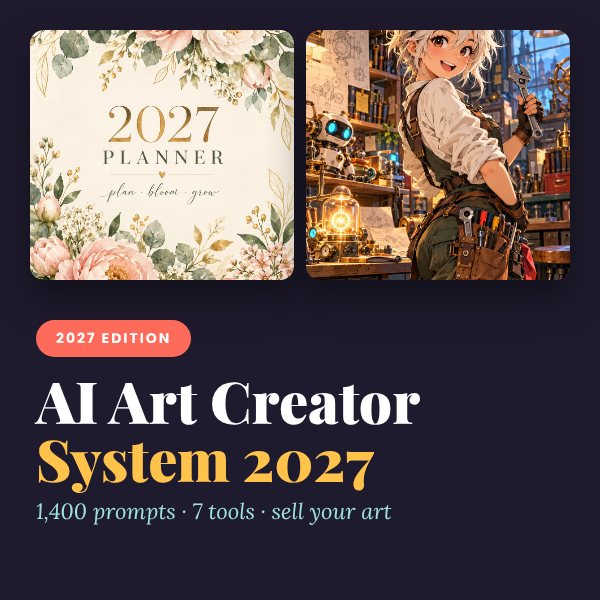
Want 1,400 prompts ready to use?
Our AI Art Creator System 2027 includes 1,400 ready-to-use prompts in 14 categories in a filterable spreadsheet, 1,000+ keywords for styles, lighting, colour, mood, camera and typography, a 9-part prompt formula with real before and after examples, 5 prompt generators and a guide to turning images into products. If selling is your goal, read how to sell AI art next.